Website and content by ViaDelCastello Monterongriffoli, except where otherwise attributed.
Images and text may not be used without permission

The Lower Village
Click on any cropped thumbnail for full image, captions ("i"), scroll feature and access to full screen option

"Pienza 12. agosto. Da questo Reverendiss. Sig. Canonico Gio. Domenico Pellegrini Pro-Vicario Generale di questa Città, e Diocesi fu il dì 10. del corrente solennemente benedetta la nuova Chiesa Plebana del Castello di Monteron-Griffoli dedicata al Martire S. Lorenzo; non solo decorata, e per scelta musica e per il numeroso popolo da' circonvicini Paesi venuto a godere della sacra funzione. Questa riuscì di somma soddisfazione stante un fervoroso discorso fatto in tale occasione dal Padre F. Giuseppe Deodato Cotolenghi Agostiniano oriundo di Fouano di Piemonte, e attualmente Reggente nel Convento di S. Martino di Siena." ["Pienza, 12th August. The new parish church of the Castle of Monteron-Griffoli, dedicated to St. Lawrence Martyr, was solemnly consecrated by the Most Reverend Canon Gio. Domenico Pellegrini, pro-vicar general of this city and diocese on the 10th day of the present month. The occasion was enhanced not just by choice music but also by the presence of a large number of people from neighbouring villages who had come to rejoice in the sacred function. The service passed off to the great satisfaction of those present thanks to a fervent address made to mark the occasion by Father F. Giuseppe Deodato Cotolenghi of the Augustinian order, a native of Fouano in Piemonte, head of the Convento di S. Martino in Siena."]
Gazzetta Toscana, 1780, No. 35
The Monterongriffoli coats of arms
Five coats of arms adorn various buildings in Monterongriffoli. There is a carved stone winged dragon (or wyvern) on an escutcheon above the entrance to the westernmost wing of the Fattoria - seemingly of considerable age.
And there are polychromed gryphons on escutcheons, apparently of terracotta and all of identical design, in four locations, including:
- on the house at the top of Via Sant'Emidio at the entrance to the village
- on the building housing the old olive press in Via di Mezzo
- and above the central entrance to the Fattoria.
These have the head and wings of an eagle and the body and tail of a lion and are therefore unrelated heraldically to the wyvern above the west door of the Fattoria. They are of comparatively recent date - perhaps no older than the 19th or even early 20th century.

The older stone coat of arms relates to the Borghesi family, who were lords of the manor of Monterongriffoli from the 16th to 19th centuries. The full Borghesi arms consist of a winged dragon about to take flight, surmounted by an eagle ("D'azzurro al drago sorante d'oro; al capo dello stesso caricata di un'aquila di nero").

It has key features in common with a coat of arms displayed on the walls of the historic Villa La Consuma in the centre of nearby San Giovanni d'Asso (left). In San Giovanni d'Asso, the escutcheon is surmounted by a bishop's mitre which, along with the carved initials "C B", relates it to Camillo Borghesi, Bishop of Montalcino in the years 1600-1607 and Archbishop of Siena 1607-1612.
As for the more modern escutcheons, the red gryphon ("gryphon gules") on a blue ("azure") field coincides with the coat of arms of the Griffoli de' Montecchiesi family, a branch of Sienese nobility quite distinct from the Griffolis who (if a number of 18th and 19th century sources are to be believed) originally gave the village its name. The design is therefore likely to be an example of fake or fanciful heraldry, a confection belonging to the relatively recent past, possibly dating from the ownership of the Monterongriffoli estate by the Bellugis (who succeeded the Borghesis in the mid-19th century) or the Vallecchis (the 20th century owners).
As the coat of arms of the putative Monterongriffoli Griffolis would not have featured a gryphon, the Griffoli de' Montecchiesi arms with its prominent gryphon would have served as a handy approximation of what the village's arms "ought" to look like.
An example of the original Griffoli arms is to be found at the Palazzo Comunale in nearby Montalcino. An accompanying inscription of 1579 commemorates the services to the town of a member of the Griffoli family (whose first name is no longer legible because of the deterioration of the marble). The (gryphon-less) escutcheon features two diagonal bands ("bends") charged with three fleurs-de-lis each. Details here:
https://catalogo.beniculturali.it/detail/HistoricOrArtisticProperty/0900465402

Villa Entrance
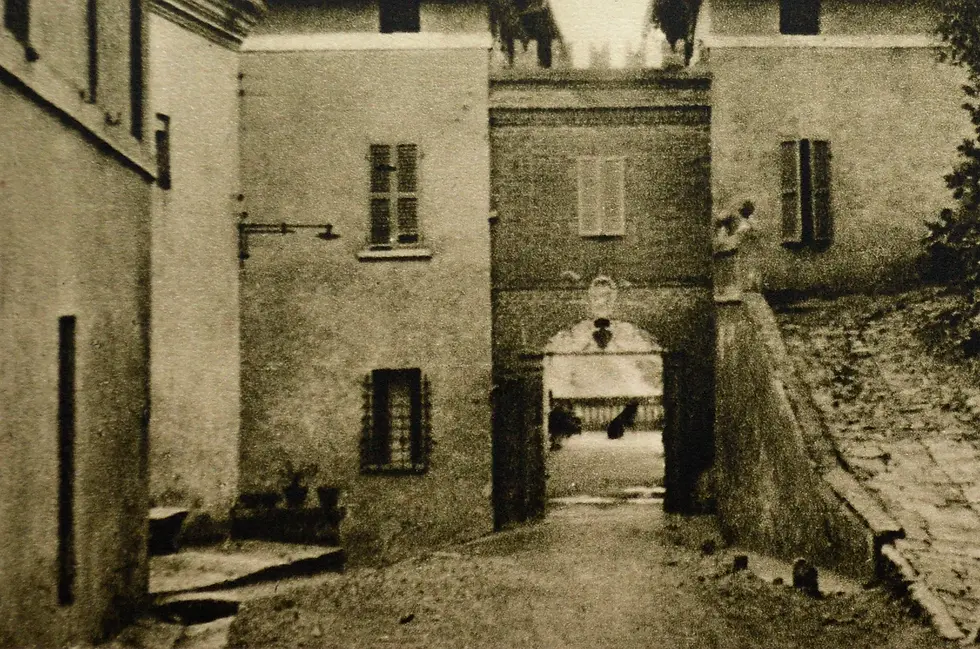
Another coat of arms surmounted the entrance to the Villa courtyard until two decades ago but disappeared during renovation work; its present whereabouts are unknown.
An old photograph (right) of the now-destroyed entrance arch and gate indicates that it depicted a Borghesi wyvern similar to the one that survives on the west wing of the Fattoria.
Of note are the Maltese Cross set into the left leaf of the wooden gate (above the door knocker) and the wrought iron over-door panel with its central amphora motif. All are now missing, and the entire entrance arch with all its fittings is now just a gaping hole in the masonry.

A bloodstained harvest
No history of Monterongriffoli is complete without reference to an infamous confrontation between farm workers and armed police that resulted in the shooting dead of a number of protesters outside the villa in 1920.
The "Monterongriffoli Massacre" (eccidio di Monterongriffoli) took place against the background of the "Two Red Years" of social unrest and political instability in Italy in 1919-1920 (the so-called Biennio Rosso).
On 17th July 2020, at the height of the annual grain harvest, when the countryside was in the grip of a general strike called by socialist trade unions, a group of carabinieri arrived in Monterongriffoli to provide protection to local farm workers intent on proceeding with threshing work in the fields. Their presence had been requested by Aldo Bellugi Gragnoli, the owner of the Monterongriffoli estate.
A violent confrontation erupted when a crowd of strikers turned up at Monterongriffoli from nearby San Giovanni d'Asso to demand the release of three detained farm workers. They advanced to the end of the village to confront a group of carabinieri stationed at the villa, commanded by a police chief and a marshal of carabinieri.
The details of what happened next are disputed, with each side blaming the other for the violence that ensued. An account published in the conservative newspaper La Vedetta Senese said that the protesters "launched a full-scale attack" on the carabinieri, "striking them with sticks and committing acts of violence". "The Carabinieri defended themselves with the butts of their rifles, trying to shield themselves from blows delivered with such force and fury that one of them had the stock of his firearm broken when it was struck with a stick." To avoid being overwhelmed, the carabinieri "opened fire to disperse the crowd".
In a conflicting account of what happened that day, the socialist newspaper Bandiera Rossa - Martinella insisted that the "peaceful workers" had been fired on without warning as they approached the villa. "You could see the contorted face of the police chief, shouting as he fired; the marshal of carabinieri and his men copied him; and the same was happening from the windows of the farm estate building." According to the same account, the carabinieri then gave chase to the protesters, clubbing them with the butts of their rifles.
Whatever the precise sequence of events, when the dust had settled three of the protesters were dead and another six wounded. There were accusations that some of the shots had come not from the carabinieri but from civilians, including the estate owner Aldo Bellugi himself.
A year later, a number of the protesters were convicted of assault against law enforcement officers, while Bellugi and a relative were cleared of murder and acts of violence.
Sources:
- La Vedetta Senese, 19-20 July 1920, p. 3
- Bandiera Rossa - Martinella, 25 July 1920. p. 1
- Toscana Novecento website:
https://www.toscananovecento.it/custom_type/leccidio-di-monterongriffoli-17-luglio-1920/

March on Rome commemorative medal, obverse
A medal lost and found
In October 2022, supporters of Benito Mussolini, attracted, among other things, by his public safety agenda and promise of an end to the social instability exemplified by the Monterongriffoli events (see "A bloodstained harvest", above) converged on the Italian capital, ushering in the Mussolini era. One of the bronze medals issued to participants of the "March on Rome" was found in the grounds of a property adjacent to the Villa of Monterongriffoli in recent years. It may have been deliberately discarded towards the end of World War II to dispose of evidence of the medal holder's pre-war political allegiance.

March on Rome commemorative medal, reverse